| The most famous of these is his monumentally important
painting of 1907, Les Demoiselles d’Avignon, which
is viewed by art historians as the prototypical modern painting.
This seminal work is perhaps the most prized painting in the entire
collection of the Museum of Modern Art, New York.
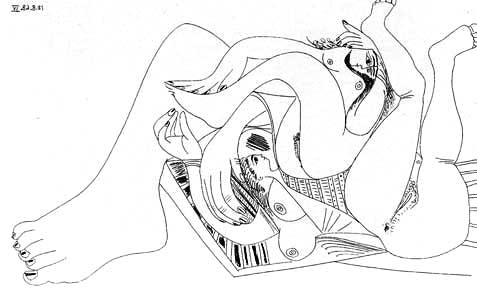
But, of all of Picasso’s multitudinous erotic adventures in
various media, the etchings are by far his most important body of
work. They are not merely numerous, rather each is highly charged
with the unbridled life force that infused all of his best works,
erotic and otherwise. The range of emotion and sensation is tremendous,
communicated not merely through narrative imagery but more fundamentally
in lines, textures and compositions that embrace the lust, delicacy,
pathos and humor of unabridged human sexuality.
While Picasso’s interest in Eros may have exceeded that of
many of his contemporaries, one cannot dismiss the relevance of
the subject with respect to then contemporary socio-cultural issues.
With regard to psychology, the first half of the 20th century was
dominated by the Freudians, with much emphasis given to the far
reaching role of sexuality in shaping emotion and behavior. This
occurred in concert with the birth of modern anthropology which
showcased surviving tribal cultures, particularly their naturalism
inclusive of nudity and the ritualized adulation of fertility. This
stood in stark contrast to the culture of the work ethic which had
come to dominate Western industrial civilization, just as the trappings
of academic art had threatened to suppress more vital and relevant
modes of expression.
The American art scene is viewed as notoriously puritanical by most
arts professionals, here and abroad. A major exhibition of Picasso
erotica was organized for 2001 by the Picasso Museum, Paris. Some
5000 people attended the opening at the Jeu de Paume. The show traveled
to the Montreal Museum of Fine Arts whose Director, Guy Cogeval,
stated, “My American colleagues said they’d love to
do a show like this, but they can’t with their boards of trustees.”
(As quoted in Forbes Magazine, 2/28/01.) Leslie Sacks Fine
Art, being a privately owned gallery without a board of trustees
and government funding, does not have to deal with curatorial politics
and is pleased to present, Picasso: Erotica. |