In the Curator’s
Statement:
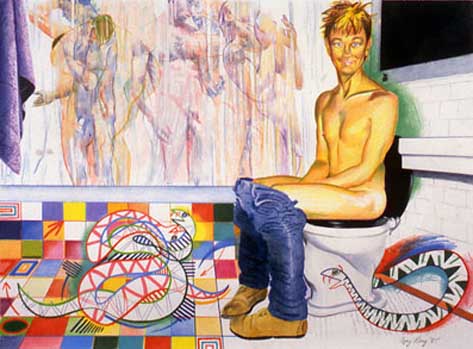
...as I reviewed
the thousands of images available to curate this exhibition,
I consciously looked for artists whose representations of
themselves in one way or another seemed to want us to see
them -- not simply as artists who are skilled with paint
or pencil or Pentax, but as beings who have shared airspace
and earthspace with us. "This is, in some small part,
who I am," these images seemed to say to me. "I
want you to know I was here."
Reed Massengill is a widely published writer and photographer
whose work spans the genres of literary biography (Portrait
of a Racist, 1994), corporate history (Becoming American
Express, 2000) and photography (Massengill,
1995; Massengill Men, 1997; and Brian: A Nine-Year
Photographic Diary, 2000). As a collector, curator and
editor, he has produced several volumes of male nude photography,
including Roy Blakey's '70s Male Nudes (2001), Champion
(2003); and The Male Ideal: Lon of New York and The
Masculine Physique (2003). His most recent book, Self-Exposure:
The Male Nude Self-Portrait (2005) recently was released
by Rizzoli/Universe.
As a writer, his work has been nominated by its publisher
for the Pulitzer Prize for Biography (Portrait of a Racist)
and has been translated into nine languages (Becoming
American Express). As a photographer of the male nude,
in addition to three monographs, his work has been widely
published and exhibited both in the United States and abroad.
His images are included in a number of important photographic
anthologies, including Exposed (2000) and Male
Nude Now (2001).
He is an avid collector of vintage male nudes, particularly
those from the era of classic physique photography, and museums,
gallery owners and private collectors frequently seek his
advice and expertise when acquiring images, conducting research
or seeking attribution.
Founded
in 1988 by arts professionals as a response to the effects
of AIDS on the arts community and as a way of organizing artists,
arts institutions, and arts audiences towards direct action,
Visual AIDS has evolved into an arts organization with a two-pronged
mission: 1) Through the Frank Moore Archive Project, the largest
slide library of work by artists living with HIV and the estates
of artists who have died of AIDS, Visual AIDS historicizes
the contributions of visual artists with HIV while supporting
their ability to continue making art and furthering their
professional careers, 2) In collaboration with museums, galleries,
artists, schools, and AIDS service organizations, Visual AIDS
produces exhibitions, publications, and events utilizing visual
art to spread the message “AIDS IS NOT OVER.”
The Body is now the most frequently visited
HIV/AIDS-related site on the Web, according to the Medical
Library Association and also the most frequently visited disease-specific
site on the Web, according to Hot 100. The Body contains a
rich collection of information on topics ranging from HIV
prevention, state-of-the-art treatment issues, humor and art.
An invaluable resource, The Body is used by clinicians, patients
and the general public. Part of The Body's mission is to enable
artistic expression to reach the Web, and to join art with
other resources needed to help the public comprehend the enormity
and devastation of the AIDS pandemic and to experience its
human and spiritual dimensions. |