| August 1 - 31, 2009 | Online |
Visual AIDS and The Body
present:
Marching AIDS Heroic
Curated by Charles Ryan Long
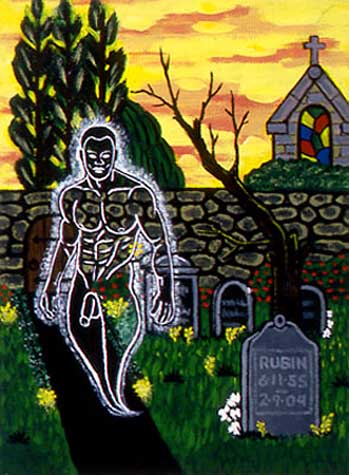
RUBIN GONZALEZ
Untitled #7
2004, acrylic on canvas, 12" x 9"This month, Charles Long curated the current on-line exhibition which features the artwork of Archive Members: David Abbott, Michael Berube, Brent Nicholson Earle, Rubin Gonzalez, Sunil Gupta, Derek Jackson, W. Benjamin Incerti, Tim McCarron, Richard Renaldi, Christopher Trujillo, Tseng Kwong Chi, and Stephen Varble.
NOTE: Previous exhibitions are also available on the website.
In the Curator’s Statement:
When the folks at Visual AIDS first approached me about curating a Web-gallery, I was honestly shocked. I've been involved in the world of AIDS for over a decade, but the intersection of AIDS and visual art, while important to me, was not something I considered an area of expertise. Flattered, I agreed despite my feelings of inadequacy and took the flattery and opportunity to explore The Frank Moore Archive Project. The amazing work contained within the archives is awe inspiring and a powerful living example of the contributions of the HIV+ community, not only to the art world but also to society as a whole. As I began to comb through the seemingly endless slides contained in the archive, I attempted to clear my mind and approach it without specific intention, seeking works that called out or spoke to me. The following selection is what came from this experiment and upon my reflection three themes have emerged.
The first one is Death and the larger role it plays in the lives of those who are living with a chronic condition. Having lived with and amongst AIDS for many years the role that our own demise plays in our consciousness is extremely intriguing. It is my belief that living with HIV/AIDS is a constant and almost daily reminder of the fragility of life. The dependency on medications, which ravage the body and spirit while also providing the only real solution, is ever present in the lives of people who are infected. For me this theme is floating in Tim McCaron's Self Portrait, in which the IV is stabbing him in the windpipe, and in Michael Berube's Millennium Pieta, which haunts us with imagery of the Virgin Mary and her ultimate sacrifice of her son. Sunil Gupta's From Here to Eternity is a stark portrait of a body laid to rest in swaddling cloth, while Rubin Gonzalez's Untitled #7 resurrects a healthy and strapping man from his grave. All these portraits of death for me are juxtaposed to my second theme of Super Heroes.
In David Abbott's Super Heroes we encounter three men dressed as familiar comic book heroes. The idea of being superhuman or having powers beyond the typical human capabilities is also of high interest to me. It seems to me that people living with HIV/AIDS need to live beyond the common man's ability, balancing their humanity with the battle raging inside for their life. In Brent Nicholson Earle's Flame On, Johnny Flame swoops in to save the day. In Christopher Trujillo's Zaire Forest (Man) a man/tree supports life and provides coverage to creatures of the forest, while balancing an enormous weight on his shoulders. In Richard Renaldi's Fresno (Tony and His Horse Max), a real life cowboy sits atop his horse, striking a heroic pose and stern sense of justice upon his face. In Derek Jackson's Mexico, someone or something is either drawing us in or reaching out for us. All of these images embody the need to be stronger than average, to be a protector of one's self and the world around us, and also lead into my last theme, AIDS Activism.
W. Benjamin Incerti's Untitled print brings us into a scene from a parade or march in which a crowd of disapprovers taunts and yells. One person holds a sign with a picture of Jesus declaring "I will not allow science to find a cure for AIDS". The image captures the essence of why activists during the early part of the epidemic fought so hard and why those of my generation continue to fight today. The hate and disgust that is hurled at people with AIDS from certain parts of the community is not new nor is it fading. In Stephen Varble's Blind Walk Performance, a man walks blindfolded carrying what I interpret to be a cross behind a "police line." The image communicates serious intention on the part of the subject behind his protective barrier marching towards whatever resurrection may lay right outside the shot. Tseng Kwong Chi's Cotton Field from the "East Meets West" series is not an image of direct action but is significant because of the distance traveled it alludes to. He stands in fields where slaves were forced to labor, yet a softness is communicated and a freedom to move is brought to light.
The process of selecting these works brought into focus themes of Death, Super Heroism and AIDS Activism. None of these were intended themes, but all directly reflective of my life. I balance them as I move through life, seeing value in each separately and strength in them collectively. At times I may be keenly aware of one or the other but through this opportunity I have discovered just how interwoven they all are and how they shape what I see, feel and create.
b i o g r a p h y
Charles Long is the Director of Development and Communications for The New York City AIDS Housing Network (NYCAHN) in Brooklyn, NY. He is a master of nothing and a student of all; he is originally from Chicago but currently lives in Brooklyn, USA. He thanks all those who take the time to reflect on their actions and the world around them.
Every month, Visual AIDS invites guest curators, drawn from both the arts and AIDS communities, to select several works from the Frank Moore Archive Project.
Founded in 1988 by arts professionals as a response to the effects of AIDS on the arts community and as a way of organizing artists, arts institutions, and arts audiences towards direct action, Visual AIDS has evolved into an arts organization with a two-pronged mission: 1) Through the Frank Moore Archive Project, the largest slide library of work by artists living with HIV and the estates of artists who have died of AIDS, Visual AIDS historicizes the contributions of visual artists with HIV while supporting their ability to continue making art and furthering their professional careers, 2) In collaboration with museums, galleries, artists, schools, and AIDS service organizations, Visual AIDS produces exhibitions, publications, and events utilizing visual art to spread the message “AIDS IS NOT OVER.”The Body is now the most frequently visited HIV/AIDS-related site on the Web, according to the Medical Library Association and also the most frequently visited disease-specific site on the Web, according to Hot 100. The Body contains a rich collection of information on topics ranging from HIV prevention, state-of-the-art treatment issues, humor and art. An invaluable resource, The Body is used by clinicians, patients and the general public. Part of The Body's mission is to enable artistic expression to reach the Web, and to join art with other resources needed to help the public comprehend the enormity and devastation of the AIDS pandemic and to experience its human and spiritual dimensions.
Visual AIDS
526 W. 26th St. # 510, New York, NY 10001
Phone: 212.627.9855 · Fax: 212.627.9815
e-mail: info@visualAIDS.org
Visual AIDS Gallery