| April 1 - 30, 2010 | Online |
Visual AIDS and The Body
present:
help! hold me!
Curated by Emily Nepon
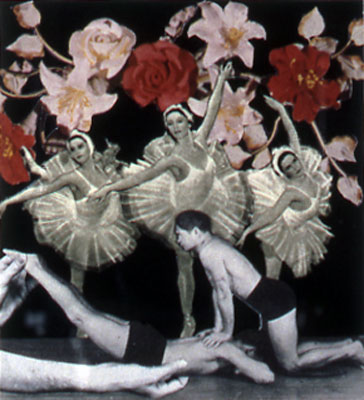
DAVID KING
"Feats of Magic (#2),"
2003, collage, 3.75" x 3.5"This month, Emily Nepon curates the artwork of Archive Members; Angel Borrero, Michael Borosky, Joe Brainard, Greg Cassin, Michael Golden, Derek Jackson, David King and Preston McGovern
NOTE: Previous exhibitions are also available on the website.
In the Curator’s Statement:
Studying these images for several months after choosing them, I'm still emotionally impacted by each one in a way that I rarely respond to art on museum walls. I chose these pieces because they made me catch my breath. Now, seeing them as a group, I think that each of the artists is giving us a wrestling match between power and vulnerability. The tensions in that false duality are exciting to me -- which parts are tender and which parts strong?
Works by Gregg Cassin, Preston McGovern, Joe Brainard, and Michael Borosky showcase a beefcake-masculinity with floral-glittery-dreamy-feminine overlay.Images of birds/bird nests repeat in works by Gregg Cassin and Michael Golden. In many cultures, birds are linked to femininity (including trans-femininity) and homoeroticism. The Yiddish word feygele, meaning little bird, is used as slang for faggot.
Derek Jackson's photos offer a harder-edged femininity, a genderqueer vamp whose tenderness isn't about the makeup but the complicated come-hither look next to the words "HOLD ME."
I think these combinations of gendered elements in work by HIV+ artists are striking together because they defy homophobia, transphobia and AIDS-phobia. In mainstream culture, those fears are so intimately intertwined -- based on negative associations that feminine = vulnerable, fuck-able, penetrate-able, weak. But really we know that the ability to take in, be vulnerable and real, be fucked, be held, ask for help ... these are hard-won strengths.
Thinking about all these pieces together, my sense of Angel Borrero's piece has shifted. At first I saw a chorus of shared desperation ... but in context I wonder -- what is strong? The tall metal buildings with thousands of isolated rooms, or the voices asking for help?
b i o g r a p h y
Emily Nepon aka Killer Sideburns aka Emil Nitrate is a writer, performer, and organizer living in Brooklyn and working at Sylvia Rivera Law Project as Grassroots Fundraising Coordinator.
Nepon learned (almost) everything she knows from ACT UP Philly and West Philadelphia's crafty queerpunks. Nepon recently wrote, produced and performed in "Between Two Worlds: Who Loved You Before You Were Mine" -- a reinterpretation of The Dybbuk exploring the ways that the next generation of queers are haunted by the first decade of the AIDS epidemic.
Every month, Visual AIDS invites guest curators, drawn from both the arts and AIDS communities, to select several works from the Frank Moore Archive Project.
Founded in 1988 by arts professionals as a response to the effects of AIDS on the arts community and as a way of organizing artists, arts institutions, and arts audiences towards direct action, Visual AIDS has evolved into an arts organization with a two-pronged mission: 1) Through the Frank Moore Archive Project, the largest slide library of work by artists living with HIV and the estates of artists who have died of AIDS, Visual AIDS historicizes the contributions of visual artists with HIV while supporting their ability to continue making art and furthering their professional careers, 2) In collaboration with museums, galleries, artists, schools, and AIDS service organizations, Visual AIDS produces exhibitions, publications, and events utilizing visual art to spread the message “AIDS IS NOT OVER.”The Body is now the most frequently visited HIV/AIDS-related site on the Web, according to the Medical Library Association and also the most frequently visited disease-specific site on the Web, according to Hot 100. The Body contains a rich collection of information on topics ranging from HIV prevention, state-of-the-art treatment issues, humor and art. An invaluable resource, The Body is used by clinicians, patients and the general public. Part of The Body's mission is to enable artistic expression to reach the Web, and to join art with other resources needed to help the public comprehend the enormity and devastation of the AIDS pandemic and to experience its human and spiritual dimensions.
Visual AIDS
526 W. 26th St. # 510, New York, NY 10001
Phone: 212.627.9855 · Fax: 212.627.9815
e-mail: info@visualAIDS.org
Visual AIDS Gallery