| January 1 - 31, 2011 | Online |
Visual AIDS and The Body
present:
ESCAPE, Visual AIDS Redux
Curated by J.J. Kegan McFadden
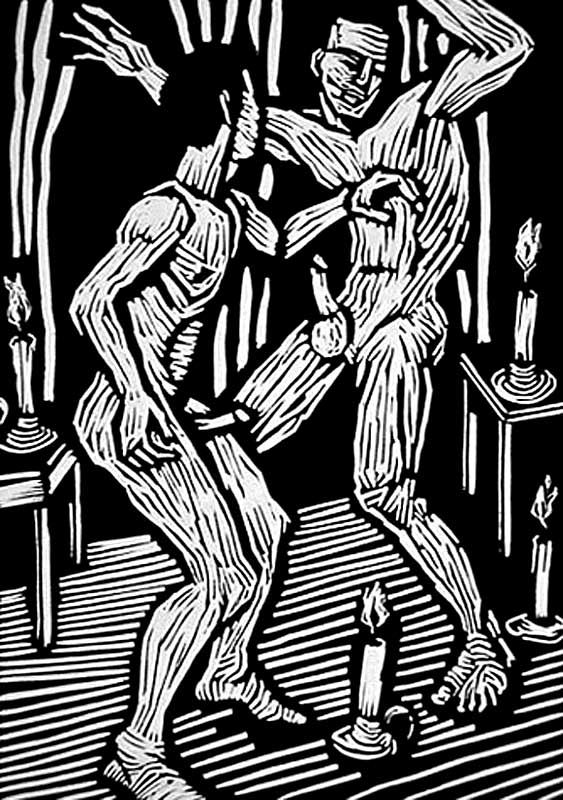
JERRY H. HOOTEN
Candle Dancers, 1995
L inocut, 12.5" x 9"This month, J.J. Kegan McFadden curates the artwork of Archive Members; Rene Capone, Jose Luis Cortes, Edgard Guanipa, Jerry Hooten, Marc Lida, Edward Lightner, Elliott Linwood, Humberto Moreno, Mark Morrisroe, Luna Luis Ortiz, J. Robert Reed, Richard Sawdon Smith, Clifford Smith, Hugh Steers, Sam Tan, Tseng Kwong Chi, TRET, Jorge Veras, Bruce Volpone, and Joel Wateres.
NOTE: Previous exhibitions are also available on the website.
In the Curator’s Statement:
All the best stories in the world are but one story in reality — the story of an escape. It is the only thing which interests us all and at all times — how to escape.
— AC Benson, Escape and Other Essays, 1916
There has always been more than one way to escape. The term itself carries with it several connotations: to flee, to transcend, to avoid. In our ever-evolving digital realm, to escape means something different altogether. When online, we escape through various quasi-anonymous discourses (blogs, chat rooms, games). The button located at the top left of the computer keyboard provides the user a means to get out of certain messy situations; to begin anew. With this selection of images, I am interested in an escape narrative. One informed by the archive, the history of story-telling, and the Hero's Journey. This escape attempt is for us all.
Divided into five stages that flow from one to the next with the click of your mouse, ESCAPE develops the way so many James Bond plots have, with various metaphors alluded to in the 20 images collected here: disguise, travel, dance, sex and meditation each become important elements of this ESCAPE route. There is a sensitivity of flow from one image to the next; oftentimes blurring the criteria that delineates one section from another. For this reason, the sequential ordering of the images in ESCAPE is important. I have attempted not only to collect this work under a specific theme, but also to shape them in order to tell a story. The plot, you might recognize, when discussing such a subject, is informed by archetypal stories.
From improvised costumes that obscure as well as embellish to not-so-subtle use of wigs and both flawless as well as garish/ghoulish makeup and accessories the images by Richard Sawdon Smith, (Simon II, 1997), J. Robert Reed (Fag Queen, 1998), Luna Luis Ortiz (Self-Portrait: Marilyn, 1996), and Mark Morrisroe (Untitled, Double Self Portrait in Drag, 1980) initiate our journey with somewhat false-starts, but we're off nonetheless.
From cartography to star charts, we immediately understand that this escape takes place as much in the world and its empirical architectural impositions as it does in the stars and wide open spaces of the natural world; but of course all journeys (and escape attempts) can't begin without the step, as seen in the work of: Elliott Linwood (Rounds, 2004), Sam Tan (Wanderlust 9, 2007), Tseng Kwong Chi (Lake Moraine, Northwest Territories, 1986), Bruce T. Volpone (The Child's Shoe, 1995).
That first single step, when done properly with much follow-through and gusto, leads to dance (and then seduction) in the work of: Humberto Moreno (Untitled #22, c. 2000-2002), Marc Lida (Dance Party, 1987), Edgard Guanipa (Untitled, 2001), Jerry H. Hooten (Candle Dancers, 1995). If we're following our map and plot twists carefully, those grand ballroom dance sequences, which so often are ignited by a daring look from across the floor, will lead (if done properly) to sex.
The images by Hugh Steers (Edges of the Bed, 1993), Edward Lightner (Jesus Had Days Like This, 1996), Jose Lius Cortes ("Frankie's" Tattoos series. 7, 2001)and Jorge Veras (The Kiss from Ginger Heaven, NYC, 1993) represent various understandings of sex during an escape attempt. Whether it's a solemn soldier perhaps in the shadow of the "Don't Ask / Don't Tell" policy or an outdoor tryst, at the pinnacle, the orgasm, we think we see the truth but are so often let down or betrayed and this is how meditation, in lieu of violence, follows.
From a solitary sunset and contemplative but complicated seascape to a whirling and winding beaded mandala and depiction of thoughts informed by intergalactic connections, here meditation is pictured with the work of: Joel Wateres (Silhouette Dreams, c. 1998), TRET (Lifeguard Off-Duty, 2000), Clifford Smith (Untitled, 1995) and Rene Capone (Escape, 2001).
ESCAPE, like so many of our ideas, is not new; not even in my practice as a curator. I've used this premise once before on a tour of one-night screenings of experimental video that took me all over Canada, into the United States, as well as The Netherlands. Using this framework, I've substituted the video from the collection of Video Pool Media Arts Centre (who sponsored the original tour) with the Frank Moore Archive Project (the inspiration behind the sequel). This approach of revisiting past research and developing it as a template to impose on a different collection of images interests me as something that may open possibilities in reading our collective history. If we tell the same story but use different narrators and illustrators, will it end up the same?
This escape attempt, though pulled from the ether and informed with knowledge of popular references to spy narratives, might best be described as parasitical. The narrative — that is the flow from one set of images to the next to tell the story — feeds off the host; the images inform the story, unwittingly. Treating the selected images by these 20 artists as fodder for my own story might seem crass and conjure notions of the curator as appropriator. However, it is important to realize curating is not always didactic or even a practice of comparative research and analysis. Sometimes curators learn as much from the work they propose as the knowledge they hope to impart while making their selection.
Of course the notion of escapism is not new when discussing hardship; but what I would like to underscore here is that this collection is not meant as escapism, but instead as a meditation on the idea of story-telling as escape and how we have all participated in the various ways it can be understood.
b i o g r a p h y
J.J. Kegan McFadden is a writer, curator and artist living in Winnipeg (Canada) whose practice blurs the lines between cultural research and storytelling. From 2009 to 2010 Kegan embarked on a 12-city international tour of single night screenings in support of his curatorial project, ESCAPE, produced through Video Pool Media Arts Centre. The collection of 15 experimental videos by Canadian artists was inspired by escape narratives found in popular culture.
For the online Web gallery, he has revisited this approach and curated ESCAPE / VISUAL AIDS redux from The Frank Moore Archive Project. Currently the Director / Curator of PLATFORM: centre for photographic + digital arts, Kegan found himself in New York City this past June as a participant in the inaugural Curatorial Intensive with Independent Curators International, where he work-shopped the exhibition Cabin Fever, which opened at PLATFORM in October.
Every month, Visual AIDS invites guest curators, drawn from both the arts and AIDS communities, to select several works from the Frank Moore Archive Project.
Founded in 1988 by arts professionals as a response to the effects of AIDS on the arts community and as a way of organizing artists, arts institutions, and arts audiences towards direct action, Visual AIDS has evolved into an arts organization with a two-pronged mission: 1) Through the Frank Moore Archive Project, the largest slide library of work by artists living with HIV and the estates of artists who have died of AIDS, Visual AIDS historicizes the contributions of visual artists with HIV while supporting their ability to continue making art and furthering their professional careers, 2) In collaboration with museums, galleries, artists, schools, and AIDS service organizations, Visual AIDS produces exhibitions, publications, and events utilizing visual art to spread the message “AIDS IS NOT OVER.”The Body is now the most frequently visited HIV/AIDS-related site on the Web, according to the Medical Library Association and also the most frequently visited disease-specific site on the Web, according to Hot 100. The Body contains a rich collection of information on topics ranging from HIV prevention, state-of-the-art treatment issues, humor and art. An invaluable resource, The Body is used by clinicians, patients and the general public. Part of The Body's mission is to enable artistic expression to reach the Web, and to join art with other resources needed to help the public comprehend the enormity and devastation of the AIDS pandemic and to experience its human and spiritual dimensions.
Visual AIDS
526 W. 26th St. # 510, New York, NY 10001
Phone: 212.627.9855 · Fax: 212.627.9815
e-mail: info@visualAIDS.org
Visual AIDS Gallery