| November 27, 2014 - January 24, 2015 |
Berlin, Germany |
Galerie
Buchholz
presents:
Richard Hawkins & William S. Burroughs
Cerith Wyn Evans
Isa Genzken
Tom of Finland
 |
OPENING RECEPTION
Thursday, 27th November 2014 | 7 – 9pThe last few years have been weird ones, ones where I seemed to always be looking over my shoulder into my own past. I’ve sometimes felt that my tendency to jump into a medium or a body of work and then, given a couple short years – but sometimes as abruptly as only one month – bounce into yet another just as blindly, were all just ways of flushing out, indulging and then rejecting parts of myself. But those rejected parts, rejected bodies, rejected selves even, always seem to come back and haunt the next directions and projects and interests I eventually barge into. I don’t know what you would call that. Continuity through the backdoor perhaps.
Certainly the two years it took to archive and see through a number of exhibitions of the painter Tony Greene’s work was a way of not only paying back an old debt to a dear old dead friend but was also a way of checking back in with the 29 year old self I was at the time of Tony’s death. Perhaps everyone does this – and even on an everyday level – but for me, an artist who happens to be engaged in therapy almost as long as I’ve considered myself an artist, this self-archaelogizing has become the immutable (yet always mutable, I guess – that’s probably the point) core of the practice.
For this exhibition, I’ve let myself wallow in a very formative yet cracked-off bit of myself and my own practice that is now a full 3 decades old. Who and what I found was an incredibly depressed (which has always seemed the primary reason I wanted to disengage and forget him) though quite precocious and driven 23 year old who was in the midst of inventing the – also, admittedly, often quite incredibly depressed – artist I would eventually become.
This younger, alienated (and even alienated from my own later self – that also is the point) self is primarily represented in the exhibition by the 26 page work-on-paper “Still Ill: An illuminating manuscript”. One should be able to tell, at least by the title, the effect that the first album of The Smiths (also 1984) had on me at the time but also, through my attempts at relentlessness, repetition and extreme cabin-fevered pessimism in the piece’s language, the influence of the first English translations of Thomas Bernhard. Less obvious, though, are the effects of Tom Lawson’s “Last Exit: Painting” on a (granted, incredibly naïve) young artist wrestling with (in the midst of a part of the country, Texas, which is somewhat known for its conservative isolationism and at a school, U.T. Austin, where Painting, with a capital P, was taught without the merest hint of contemporary criticality) how to make his own work “smarter”. The solution, embarrassing (though hopefully quite charming) to admit, was that if painting was dead, as Lawson seemed to indicate, to fill up the picture’s rectangle with “information”, albeit of a very self-deprecatingly narcissistic – or one could even say, superegoical … or superegotistical – form of glossolalia or graphomania.
A couple of other things to point out that would become important much later: The first is that the pages of Still Ill, though consisting principally of writing, were my first serious attempts at collage. Even at this early stage the fetishistic – or almost sacrificial aspect – of the collage elements were crucial. I seemed to have never thought of a magazine page as just readily available / easily replaceable detritus symbolizing the glut of popular culture but, instead, as objects “charged” in some way, ultra-important in that these were personally favorite pictures – either cut from the pages of my favorite porno magazines or caught, with some great degree of patience, determination and labor, with a polaroid from the favorite moments – or one could even say the most personally ecstatic moments, the “cum-triggers as it were” – of my favorite porn and mainstream videos. Severed from their revered place in my stash of masturbation materials, these treasures carried with them, for me, a kind of devotional quality.
Though I’ve never spoken of these early works, or indeed even thought of them in the following manner, now – with some great distance – I have begun to remember that not only was 1984 the summer of the first Smiths album, of my own infatuation with Bernhard, of some vain attempts to make an artistic practice out of something “more engaged” than painting, it was – in Austin at least, where I was living at the time – the first (I’ve rewritten this several times trying to make it less auspicious … but it was, seriously, so incredibly auspicious that I have – for decades now – put it completely out of my mind) summer of the epidemic and the first deaths of close friends and lovers.
I have been calling the new paintings in the exhibition from 2014 gifts … quirky, odd, slightly raunchy and hopefully very joyfully and gaily painted presents sent back in time with the following note:
“Dear 23 year old me,
Lighten the fuck up, sweetcheeks. I’d like to say things get better – but they don’t really. At least not for a long long while. If you can keep from throwing yourself off a bridge between now and then though there will someday be this amazing invention called anti-depressants. I suggest you take as many as your little heart desires. But otherwise, if you stick it out you can look forward to meeting amazing friends you’ll love and cherish much more than family, mountains of books to dig into, pervy old men to teach you how to be just like them, loose boys to chase all over the globe… And besides that much much much more porn, gallons and gallons more poppers and some incredible drug trips you’ll be far from happy if you miss out on. So just ease up and enjoy it if you can.
Much love little buddy, Take care – You at 53.
PS: You do realize you just turned yourself into pretty much of a half-decent writer though. Don’t you?
PPS: Oh, and painting. Have yourself a field day – who the fuck cares?”In putting together this show though, I’ve also indulged that other particular passion of mine – call it “research” if you will – but I prefer to look at it as honoring a few of influences over these past 30 years, paying back even more old debts in the sense that, obviously, being influenced by becomes a very complicated mirror for (re)casting new reflections back onto the self. So, the chance to dig into the Estate of William S. Burroughs and find his remarkable alterations of homely office supplies, to work closely with the Tom of Finland Foundation to unearth some of his lesser-known “reference file” collages and to make even the slightest nod toward the idol that is Cerith Wyn Evans serve as a kind of faggot patrimony for a self that’s always been made up of a matrix of directions to head toward and permissions derived from inspirational predecessors.
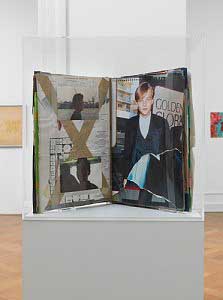
The inclusion of Isa Genzken’s collage book was fortuitous. It’s own recently come to light from within Isa’s archive but I can think of no greater gay man to pattern myself after other than Isa herself.
— Richard Hawkins, November 2014
I would like to thank Yuri from the Estate of William S. Burroughs and Durk and Sharp from the Tom of Finland Foundation.
WILLIAM S. BURROUGHS
TOM OF FINLAND
CERITH WYN EVANS
ISA GENZKEN
RICHARD HAWKINS