| ABOUT THE ARTISTS
SEAN
PLATTER considers himself a victorian in a digital world.
Seans fascination with ornament and past design forms can be traced
back to the grand victorian homes of his youth. The overabundance
of detail and sense of fantasy appealed to Sean like nothing else.
Over time, this fascination lead to an appreciation for outlandish
excess, the exotic , the erotic, and all things macabre.
Sean received a degree in graphic design at a midwestern collage
and moved to Los Angeles in 1984. He has had many interesting jobs
including manually pasting phone numbers in the local phone book,
advertising for gay papers and illustrations for In Touch and Indulge
for every month from 1984 thru 2005. Sean was also an animator at
Filmation studios working on He-man and She-Ra. Sean continues to
work as a professional animator.
Sean lists his influences as- Harry Bush, Simon Bisley, The Symbolists,
The Orientalists. Hindu devotional art from India, Byzantine art
and Medieval illuminated manuscripts.
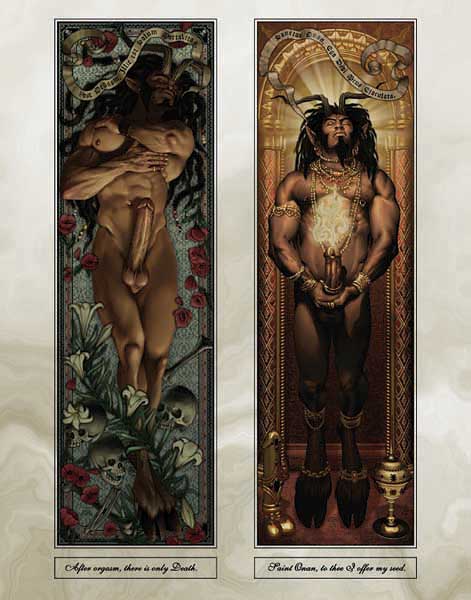
Sean is the creator of a twisted graphic novel called DEMONICSEX:
satanic tales of transformation and possession. The second volume
will be released on All Hallows Eve at Antebellum gallery!
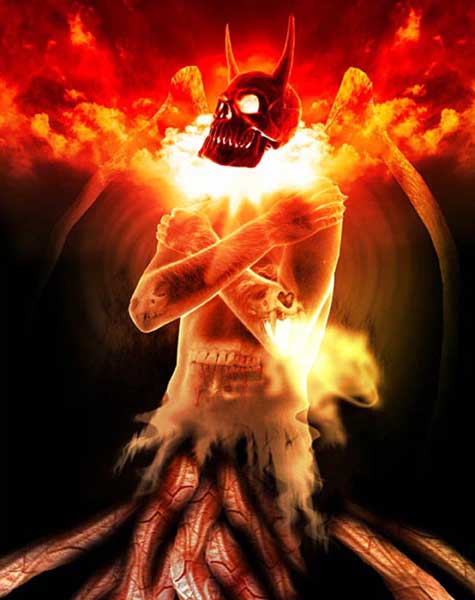
TONY "LEWD" LABADIE says "It all
started with strange dreams of lizard-men and alien atmospheres".
Lewd, says he has always had a passion for art in every form, be
it film, books, comics, photography, architecture, culture, even
food has inspired and given Lewd motivation to create.
Character illustration and the male body have been the primary
focus of lewds art and experimentation. Lewd sees the male body
as a frame of power and lust, hard, feral, and arousing, causes
him to bring forth wildly exotic fantasy that hes dreamt. Lewd says,
this gives my characters bizarre, or monstrous characteristics and
stimulates more mystery and curiosity, making experimentation with
sex much more fulfilling and enjoyable.
Monsters, demons, aliens, and other famous creatures such as the
Predator reveal their erotic potential and become objects of lust
& desire are depicted in Lewds artwork.
DON SABAN is a native of Phoenix ,AZ, he received
his formal training at Brooks Institute of Photography, Santa Barbara,
and was simultaneously a prote of professor William A. Rohrbach,
University of California Santa Barbara, who studied with classic
photographer Minor White at Berkley in the 1950?s.
Sabin has been a member of the Santa Barbara Museum of Art Photography
Committee. During his tenure in Santa Barbara, he was one of the
first photographers to be in Art Life magazine, and also on the
cover.
After moving to Los Angeles, Saban taught at Otis/Parsons and
continued his photographic work which has been published in numerous
magazines.
Don Saban was commissioned by the Santa Barbara Museum of Art to
do photography for the book : Standing in the Tempest: Painters
of the Hungarian Avant-Garde.
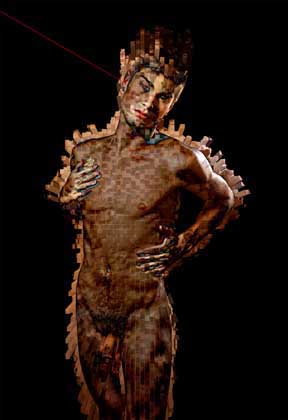
Sabans current work is experimentation with digital images working
with color and design that at once becomes spiritual, celestial
and mythical.
Don Saban says, I've always wanted to do more with photography
than what was possible when I first started out. With the advent
of digital cameras and new technology I can now realize what I've
always dreamt of doing This new body of work embraces the old with
the new, starting with an image made by a digital camera (which
still uses a glass lens, shutter and f/stops like a traditional
camera) and traditional studio lights.
In essence the image becomes somewhat of a blank canvas for me to
explore the possibilities. The digital lab has replaced the limitations
of the darkroom, allowing me to accomplish my artistic vision and
goals. Ultimately images are wonderful to look at, and what one
takes away from them is up to the individual.
PAMELA JOSEPH says her work often starts with
separate parts that come together over time to make a complete statement.
Pamela has a long-standing interest in women and their place in
contemporary society, their power or lack of it, and their relationship
to the world around them. Over the past few years, Pamela's work
has also explored different religious issues, especially the Madonna.
The Virgin Mary has been an intense attraction for Pamela, who was
raised as a Catholic. The Virgin was the ultimate symbol of feminine
perfection.
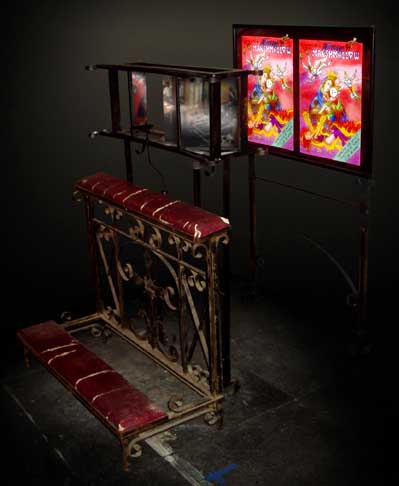
Pamela bought the kneeler about three years ago, drawn to its
textures and sense of history. At the time she had no idea how it
would manifest in an artwork.
Pamela then painted the Pussy Madonna image in 2003 while she
was a Visiting Artist at the American Academy in Rome. It was there
that Pamela became especially aware of the sympathetic juxtaposition
of the sacred and the profane: erotic scrims on buildings would
be backdrops for provocative Bernini sculptures, or a Virgin Shrine
enclosed in neon would be next to a suggestive movie poster.
Pussy Marshmallow is Pamela's alter ego, a woman who audaciously
dares to break the rules in the game of the sexes. Here she is reborn
as the Savior Christ child, resting in the arms of the Virgin Mary
while winged fairies soar and the putanesca burns in hell.
Pamela has worked with KUROSH VALANEJAD on a wide range of projects
from 1992. Kurosh suggested turning the Pussy painting into a 3-D
stereoscopic light projection and executed the separation of layers
and designed the light box. Pamela and Kurosh then engage in dialogue
to further develop the piece.
The intricate mirror box was fabricated based on similar historic
contraptions. Pamela's has been fascinated with the idea of the
phrase "They did it with mirrors," the conflict and the
indecision of what is real or merely illusion.
The Kneeler becomes a complete environment with the addition of
the text, which is based on Pamela's personal experiences and memories.
The words are a dialogue between the supposedly different personas
of the Madonna and the whore in a conversation with a paternal figure.
Sound artist Liliana Mejia took my words and wove them into a complex
overlay of voices, much like a supportive Greek chorus. She has
composed a score that interacts with other elements such as fire,
wings and music. The refusal to be judged now extends into the collective
realm and is not just an individual effort.
The image of kneeling is one of surrendering pride and admitting
ones sins. Instead, this humbling act becomes a defiant stance in
the face of rigid and perfectionist views.
ERIC OCTOBER was born and raised in the Central
Valley and then transplanted to Southern California.
After receiving a BA in Fine Art at UCLA he has pursued various
media to express his artistic ideas, including drawing, painting,
sculpture, photography, and mixed media/assemblage.
Reoccurring themes in his work include examining the ways the
male body is represented and specifically how the male body is presented
to gay men.
Currently, in addition to painting, Eric is focusing on animation
as his next artistic frontier to explore.
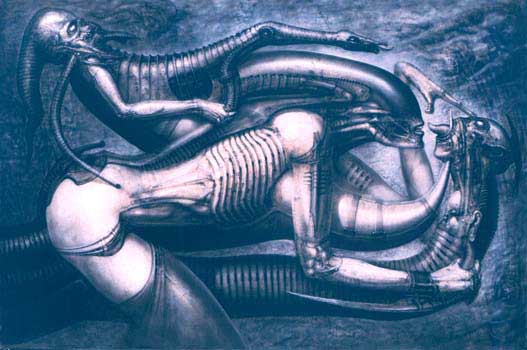
H. R. GIGER was born in the small city of Chur, Switzerland
in February, 1940. Giger grew up in a rather normal, middle class
family environment. His father was the local pharmacist. When he was
quite young his father received a human skull as a professional promotion
from a pharmaceutical firm, and the young Hansruedi was taken spellbound.
After high school (gymnasium) Giger went on to study architecture
and industrial design at Zurich's School of Applied Arts. He soon
expanded his network of friends to include those in involved in
various aspects of the arts, and began drawing creatively.
In 1966 Giger began work as an interior designer, and at the same
time, completed some early paintings. In 1968 Giger began working
exclusively as an artist, as well as filmmaker. Giger has his first
posters published in 1969 and also has some of his first exhibitions
outside of Zurich.
Giger begins using the airbrush in the next decade, and his works
take on a unique otherworldly quality. He grows to be considered
the leading airbrush artist in the world and proved that fine art
could be produced via the device. Working in large formats, Giger's
paintings are meticulously rendered and possess a blend of erotic
mystery and alien elegance.
In 1978 Giger began work on the film ALIEN, and ended up sculpting
much of the creatures and sets. In 1980 the artist is awarded an
Oscar for his stunning work on the classic film.
Giger began work on The H.R. Giger Museum in the middle 1990s and
this continues today, as the medieval castle in Gruyere, Switzerland
is being continually expanded. The museum houses Giger's personal
collection of art from around the world, as well as a substantial
collection of his own paintings and sculptural work.
RICK OWENS was born and raised in Porterville
California. Rick then studied art at Parsons in Los Angeles before
opting instead to take a two-year course on pattern-making. He then
spent a number of years cutting patterns for knock-off and sportswear
companies, before embarking on his own label. A strong reputation
and following both consumer and retailled him to the attention of
a group of Italian manufacturers, with whom he is now partners in
his ever-growing company OwensCorp. Rick designs his own clothing
lines called Rick Owens, DKSHWDS and Lilies. Owens is also Artistic
Director for Revillon, the French fur brand founded in 1723. Owens
won the CFDA Perry Ellis Award for Emerging Talent in 2002. Rick?s
designs for many celebrities including Courtney Love, Madonna, Helena
Bonham Carter and his longtime muse, Michele Lamy.
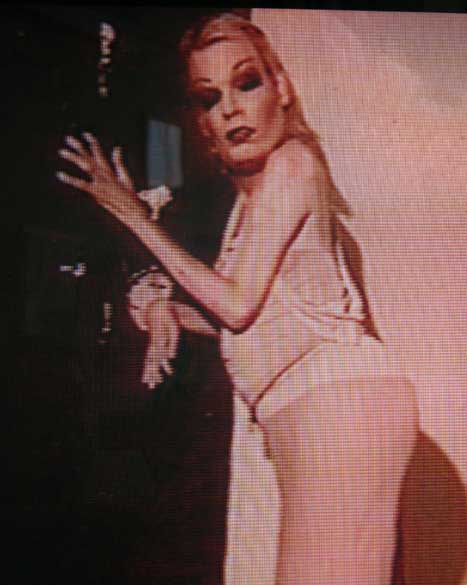
Ricks videoinstillation documents the creating of his fashion
shoot with paraplegic, transvestite model, The Goddess Bunny, who
is a celebrity in her own right modeling for art photographers Joel-Peter
Witkin and Rick Castro, and touring with Marilyn Manson.
|